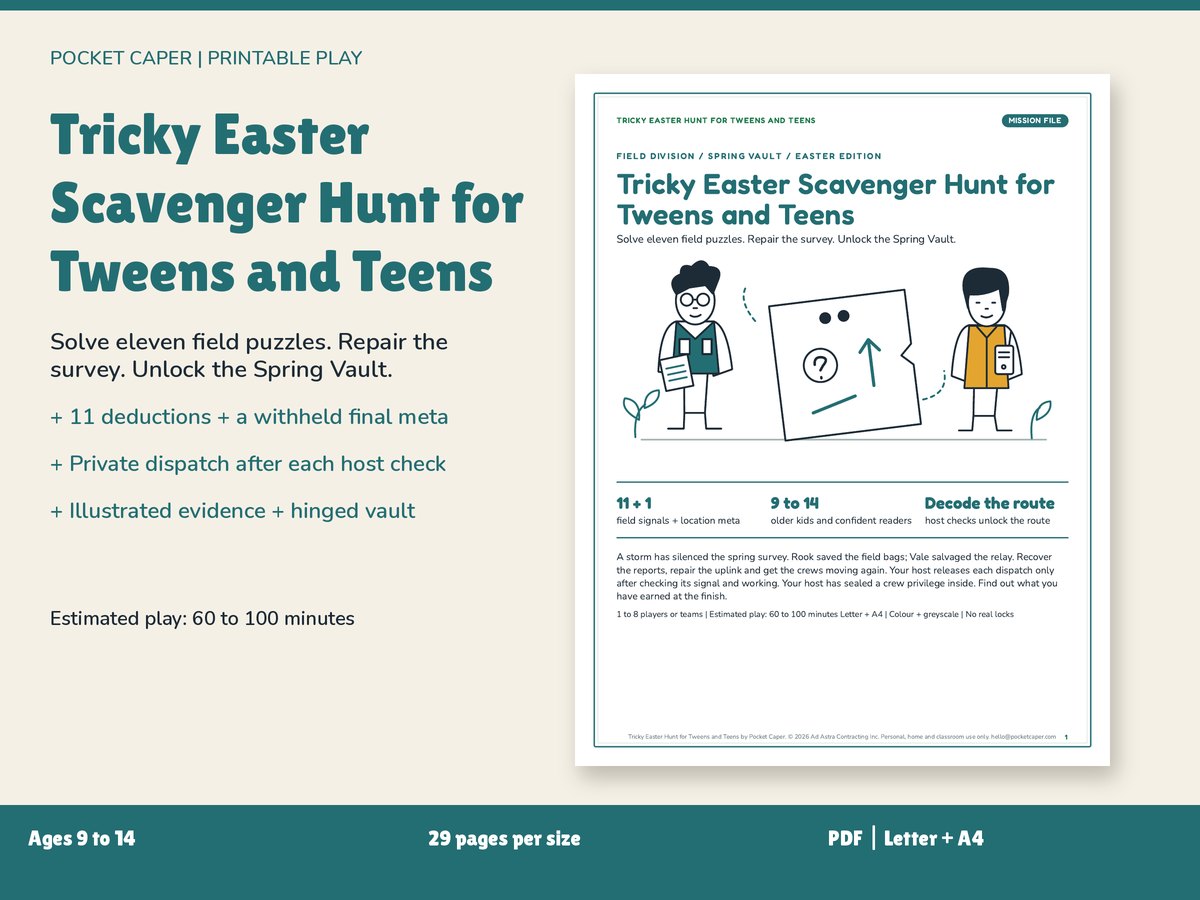
Tricky Easter Scavenger Hunt for Tweens and Teens
Solve eleven field puzzles. Repair the survey. Unlock the Spring Vault.
A spring mission with 11 linked puzzle stations, host-verified dispatches and a withheld final meta. Co-op, fair timed scoring, graded hints and a hinged paper vault.
Key facts
- Ages 9 to 14
- 1 to 8 players or teams
- Estimated play: 60 to 100 minutes
- Setup: 20 to 30 minutes
- 29 pages per paper size
What is included
- 11 deductions + a withheld final meta
- Private dispatch after each host check
- Illustrated evidence + hinged vault
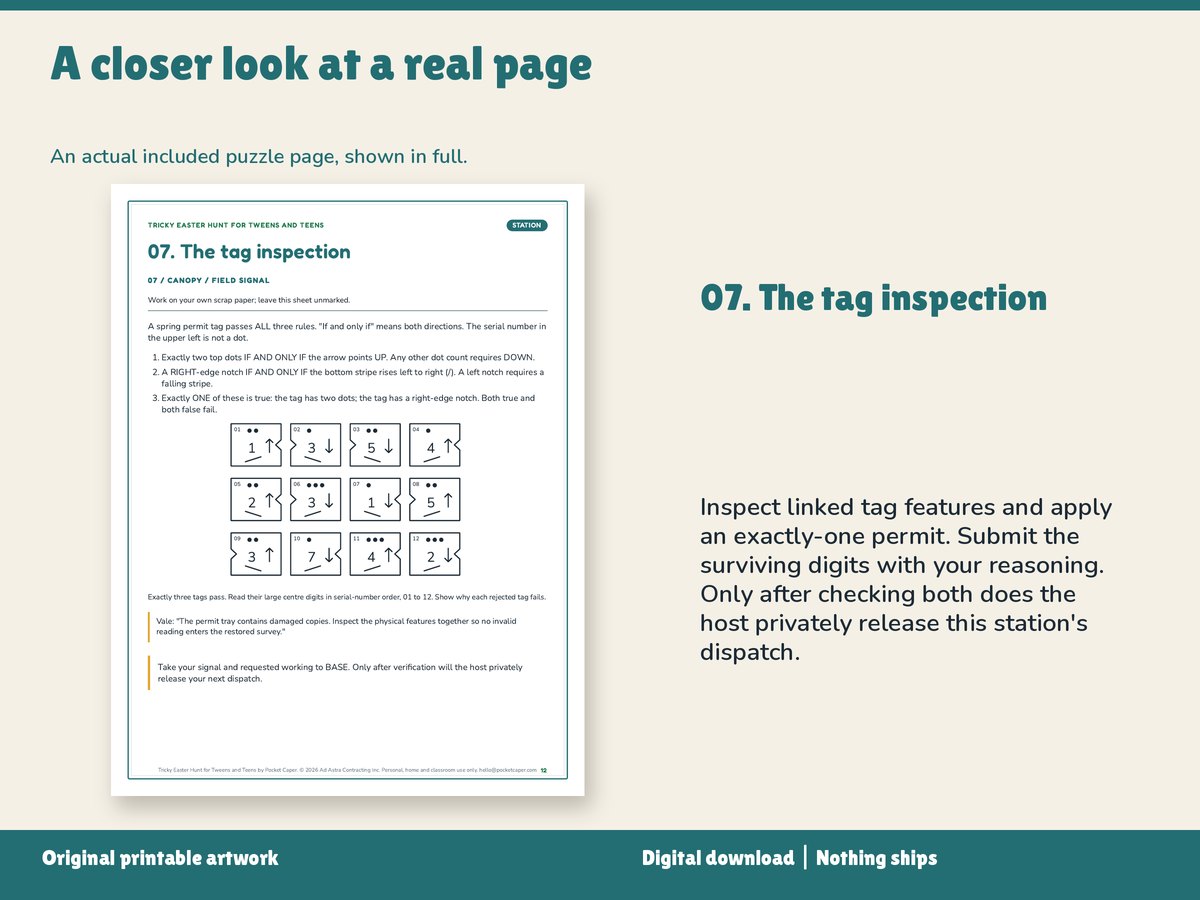
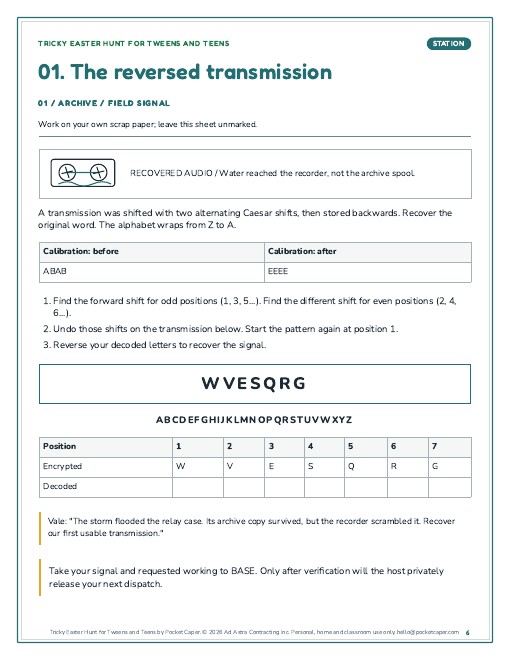
Eleven puzzles include alternating shifts and reversal, a three-category logic grid, a growing anagram chain, route selection with six move cards and no repeated cells, a four-channel number lock, competing word ladders with a permit condition, tag inspection with interacting equivalences, ordering constraints, switch logic, a directed courier network and a maximum-session dispatch board. A reusable alphabet-number reference and worked decoding example support navigation. For less arithmetic, choose guided navigation: after each verified solve the host gives the decoded destination. Use the same navigation mode for every entry.
A storm has damaged the spring survey relay. Rook the cartographer and Vale the radio technician recover soaked field bags, repair the uplink, reconcile scout records and reopen the survey. Illustrated evidence includes a damaged recorder, field bag, delivery slips, relay panels and permit file. The narrative unfolds in circuit order. Secular spring framing; no religious content.
The host seals a specific, immediate crew privilege inside the hinged paper vault before play, such as choosing the next 20-minute shared activity with the host joining in. Players discover it at the reveal. No bought prize is needed. Use reachable labelled landmarks, or labelled desk zones where fixtures are unavailable. Listing scenes and crew artwork are illustrations, not photographs.
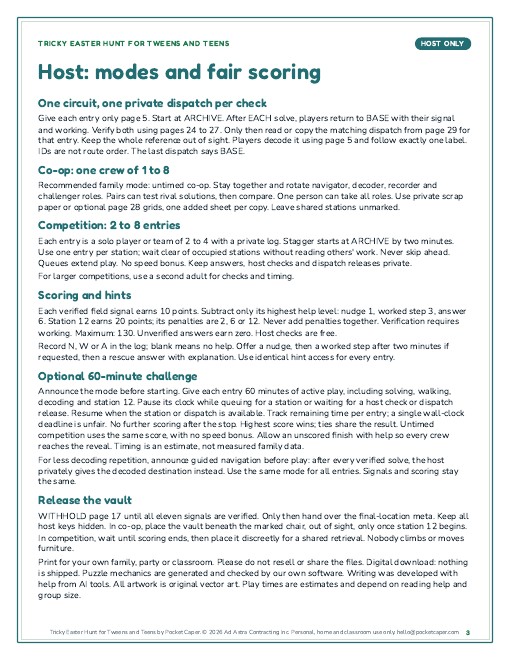
Untimed co-op is the recommended family format: one crew of 1 to 8 players rotates roles and tests rival answers together. Competition supports 2 to 8 entries, each a solo player or team of 2 to 4. Stagger starts by two minutes; one entry uses a station at a time. Keep host checks and dispatch releases private. No speed bonus; ties share the result. Optional timed scoring gives each entry 60 minutes of active play, pausing its clock during station queues and host checks or releases. Allow an assisted finish and shared retrieval after scoring.
Ages 9 to 14 with a grown-up host. Younger readers may need support with equivalences, logic and equations; experienced teens may solve faster. Estimate 60 to 100 minutes including dispatch decoding, walking to BASE after every solve, checks and the finale. Solo play, host workload and queues can take longer. These are estimates, not measured family timings. Allow 20 to 30 minutes for labels, the hinged vault and setup.
Each PDF has 29 pages: one cover, three host guides, one field log with reusable decoder, eleven full-page field stations, one final-location meta withheld until verification, one sheet of twelve landmark labels, one cut-and-hinge vault reveal, four graded-hint pages, four worked-answer pages, one optional personal logic-grid sheet and one host-only private dispatch reference. Four PDFs are supplied: Letter and A4, each in colour and greyscale. Puzzles work without colour.
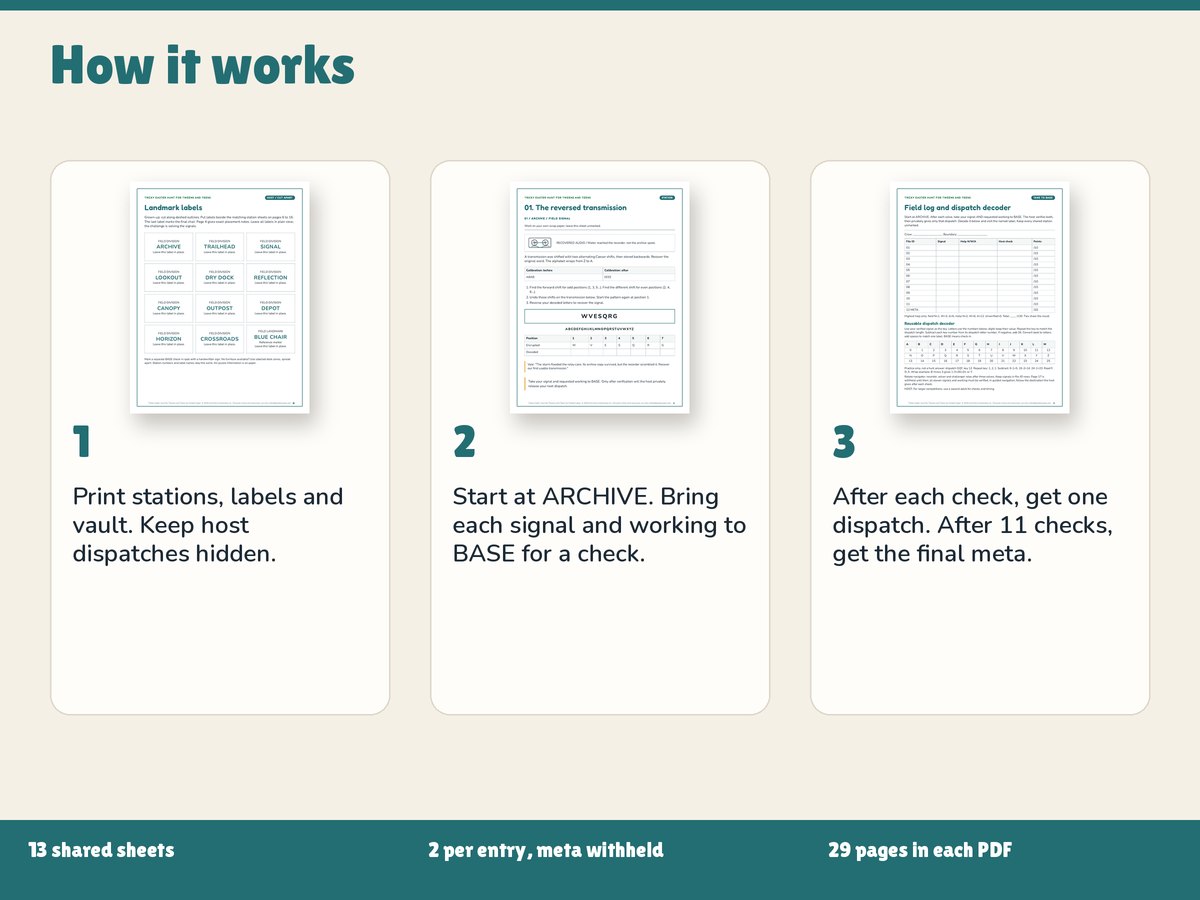
Selective core printing uses 13 shared sheets plus 2 per entry: 15 sheets for one entry, 17 for two, 21 for four or 29 for eight. Shared sheets are eleven stations, labels and vault. Each entry gets a log at setup and its meta after eleven host checks. Optional personal grids add one sheet per solving pair; otherwise use scrap paper. Keep host references, including the dispatch table, on a private screen, or print them separately. Printing the whole PDF once uses 29 sheets. An entry is one player or small team; co-op shares one entry.
Supply paper, pencils, erasers, scrap paper, tape and grown-up scissors, plus eleven reachable display spots, one BASE check-in spot and a separate stable final chair. Keep shared station sheets unmarked; working goes on private scrap paper or optional personal grids. Eggs, envelopes, phones and real locks are unnecessary. A BLUE CHAIR label identifies the final chair regardless of its actual colour. The host hides the vault until the final stage.
Every station has a nudge, a worked step and a rescue answer. Host keys give full working, decoded destinations and final-meta fragments. The exact placement table identifies one labelled location per station, and software checks the full circuit and puzzle uniqueness. Puzzle data, route and final location are fixed. Reuse for a new crew; returning solvers will know the answers.
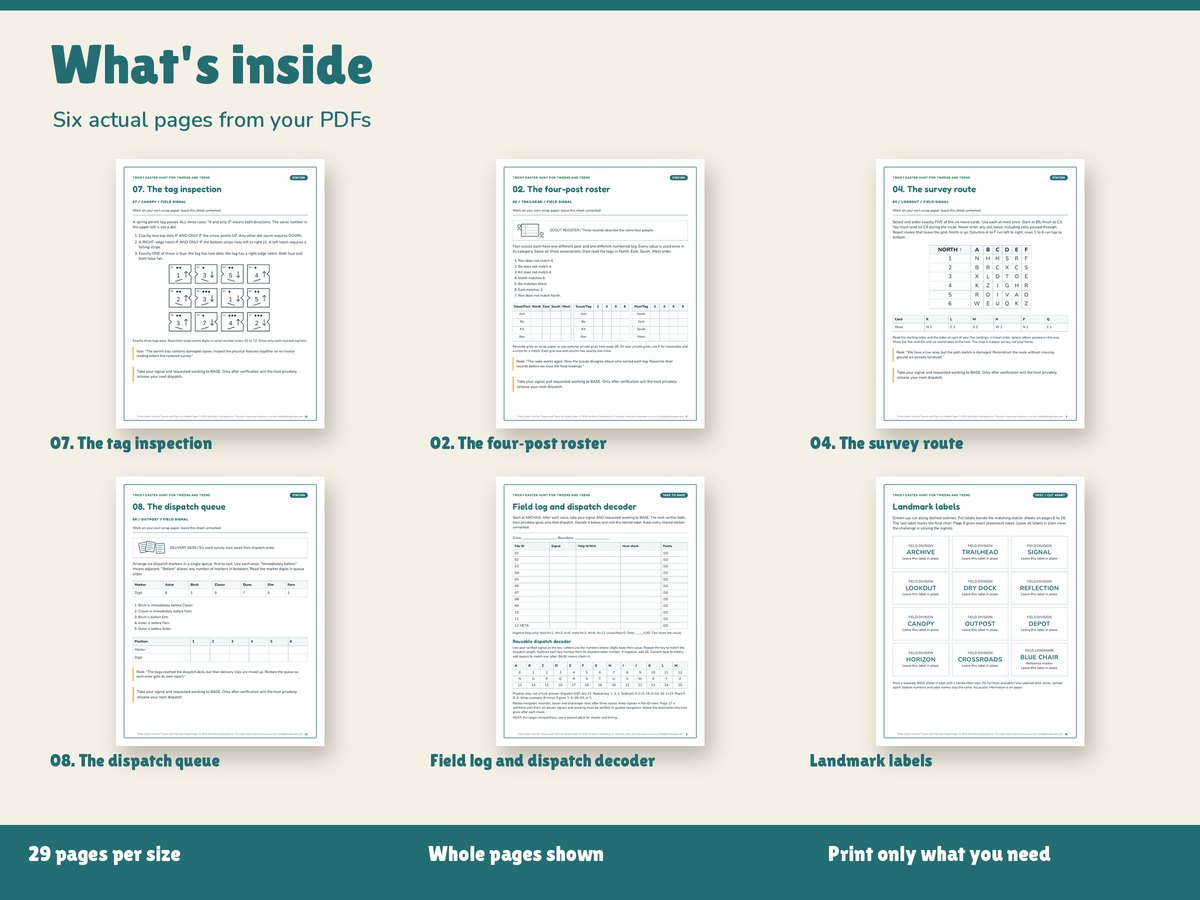
Page previews
USD 6
Digital download. Nothing ships.
Print for your own family, party or classroom. Please do not resell or share the files. Digital download: nothing is shipped.
Puzzle mechanics are generated and checked by our own software. Writing was developed with help from AI tools. All artwork is original vector art. Play times are estimates and depend on reading help and group size.
A grown-up hosts and handles cutting. Walk within the agreed search boundary. Put every station at reachable height, on dry stable surfaces away from heat and breakables. No climbing, furniture moving, opening windows, pocket searching or outdoor searching is needed. Keep the final vault on the dry floor beneath the labelled chair. Treats are optional; ask a grown-up if adding food.